No products in the cart.
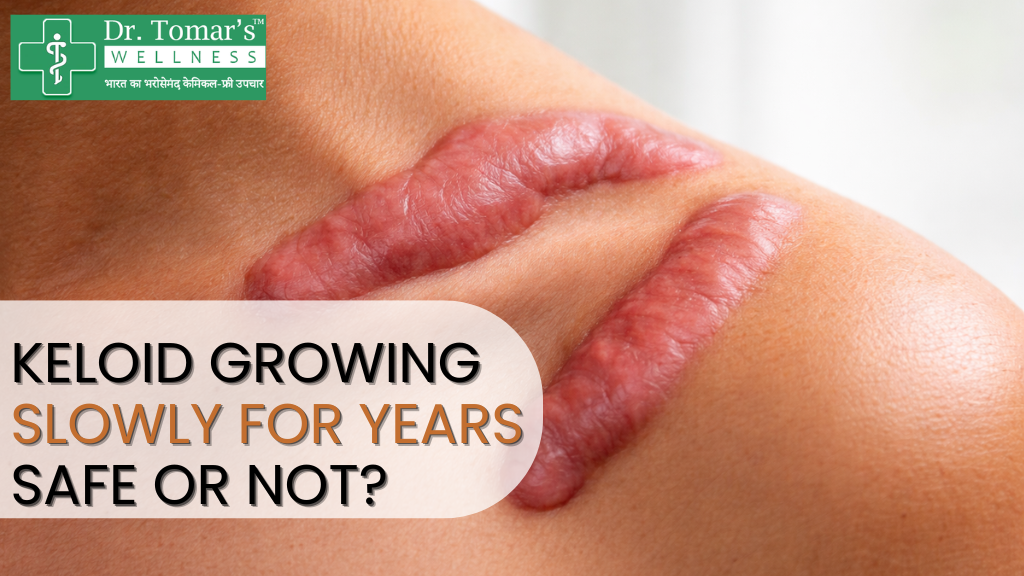
You notice a raised scar on your skin.
At first, it’s small. Then slowly — over months or even years — it becomes thicker, darker, and more noticeable.
It doesn’t hurt much. It’s not spreading like an infection. But it’s still growing.
Now the question that keeps coming back is:
If a keloid growing slowly for years, is it safe?
The honest answer is — in most cases, yes, it is medically safe.
But that does not mean it should always be ignored.
This comprehensive guide explains what a slowly growing keloid means, when it’s harmless, when to worry, and how to manage it properly.
A keloid is an overgrowth of scar tissue that develops after skin injury. It can appear after:
Surgery
Acne
Piercings
Burns
Cuts
Vaccination scars
Unlike normal scars, keloids grow beyond the original wound boundary. They may continue to enlarge slowly over time.
Typical features of a keloid:
Raised and thick
Smooth or shiny surface
Firm texture
Pink, red, or dark brown color
Slow progressive growth
Keloids are benign (non-cancerous). They are not infections and do not spread like tumors.
The body normally produces collagen to repair injured skin. In keloid formation, the healing response becomes overactive.
Instead of stopping once the wound heals, the body continues producing excess collagen. This leads to:
Thickened scar tissue
Gradual outward expansion
Long-term growth
Some keloids stabilize after a few months. Others may grow slowly for years before stopping.
A keloid that grows slowly over years is generally not dangerous or life-threatening.
It does not turn into skin cancer.
It does not spread to internal organs.
It does not damage underlying tissues.
However, “not dangerous” does not always mean “harmless.”
A keloid is usually safe if it:
Grows slowly
Is not painful
Does not ulcerate or bleed
Does not interfere with movement
Remains stable in texture
Many people live with keloids for decades without medical complications.
Although rare, certain changes require medical evaluation.
Seek professional advice if your keloid:
Suddenly grows rapidly
Becomes extremely painful
Develops open wounds
Starts bleeding
Changes color dramatically
Causes tightness limiting movement
Rapid changes are uncommon but should never be ignored.
Even if medically safe, keloids can cause emotional distress.
Common concerns include:
Embarrassment (especially on face, neck, chest, or ears)
Anxiety about appearance
Fear of cancer
Social discomfort
Frustration with long-term growth
For many individuals, the psychological burden is heavier than the physical symptoms.
And that is completely valid.
Several factors influence long-term growth:
Some individuals are genetically more prone to keloid formation.
Keloids are more common in darker skin tones.
Common high-risk areas include:
Chest
Shoulders
Upper back
Earlobes
Growth may increase during puberty or pregnancy.
Constant friction or pressure may stimulate growth.
Yes.
Many keloids eventually enter a stable phase. Growth may slow down significantly after:
1–3 years
Hormonal stabilization
Reduced irritation
However, some may continue mild enlargement for longer periods.
There is no fixed timeline.
This is one of the most common fears.
A typical keloid does not transform into cancer.
Skin cancers behave differently:
Irregular borders
Rapid growth
Ulceration
Bleeding
Color variation
If unsure, a dermatologist can confirm diagnosis through examination.
Treatment is not mandatory for every keloid. However, you may consider it if:
The keloid continues enlarging
It causes itching or pain
It affects movement
You feel emotionally distressed
It interferes with clothing or daily activities
Treatment is often chosen for quality-of-life reasons rather than medical necessity.
While complete cure can be challenging, several methods help reduce size and symptoms:
Reduce inflammation and flatten the scar.
Help soften and flatten tissue over time.
Improves color and texture.
Freezes small keloids.
May be considered in selected cases, often combined with other therapies to reduce recurrence.
Treatment plans are usually customized based on size, location, and patient goals.
Yes — if it remains stable and asymptomatic.
But monitoring is important.
Watch for:
Change in size
Pain development
Color changes
Surface breakdown
If none of these occur, it is often safe to observe.
If your keloid is growing slowly but not problematic:
Avoid unnecessary irritation
Protect from friction
Use sunscreen (prevents darkening)
Avoid self-treatment or cutting
Get periodic medical checkups
Simple monitoring can prevent unnecessary worry.
Yes. Some keloids grow gradually over years before stabilizing. Slow growth alone does not indicate danger.
No. A typical keloid is benign and does not become cancerous.
Keloids may cause mild itching due to nerve irritation or collagen activity. Persistent severe itching should be evaluated.
There is no strong scientific evidence linking stress directly to keloid growth, although hormonal changes can influence scar behavior.
If it is not painful or growing rapidly, removal is optional. Many people choose treatment for cosmetic reasons.
Surgery itself can trigger excessive scar formation in individuals prone to keloids. Recurrence risk exists.
Yes, many eventually stabilize without intervention.
A dermatologist can confirm through clinical examination. If unsure, always seek professional advice.
A keloid that has been growing slowly for years is usually medically safe.
It is not cancer.
It is not life-threatening.
It is not contagious.
But it may still deserve attention — especially if it affects your comfort, confidence, or daily life.
Monitoring, understanding, and informed decisions are the key.
When in doubt, consult a qualified healthcare professional. Peace of mind is always worth it.
Disclaimer: This article is for educational purposes only and does not replace professional medical advice. Always consult a licensed medical professional for diagnosis and treatment decisions.
Dr. Jitender Tomar is an Electropathy practitioner with 23+ years of clinical experience in natural and holistic healthcare. Through Dr Tomars Wellness, he shares educational insights on preventive health, early disease symptoms, and lifestyle-based wellness approaches to help readers make informed health decisions.








 drtomarswellness.com





Leave a comment